
Session: 2f
Time: 14.00–15.30
Room: JK2–3 1.16
Chair: Celandine Fleur Seuren
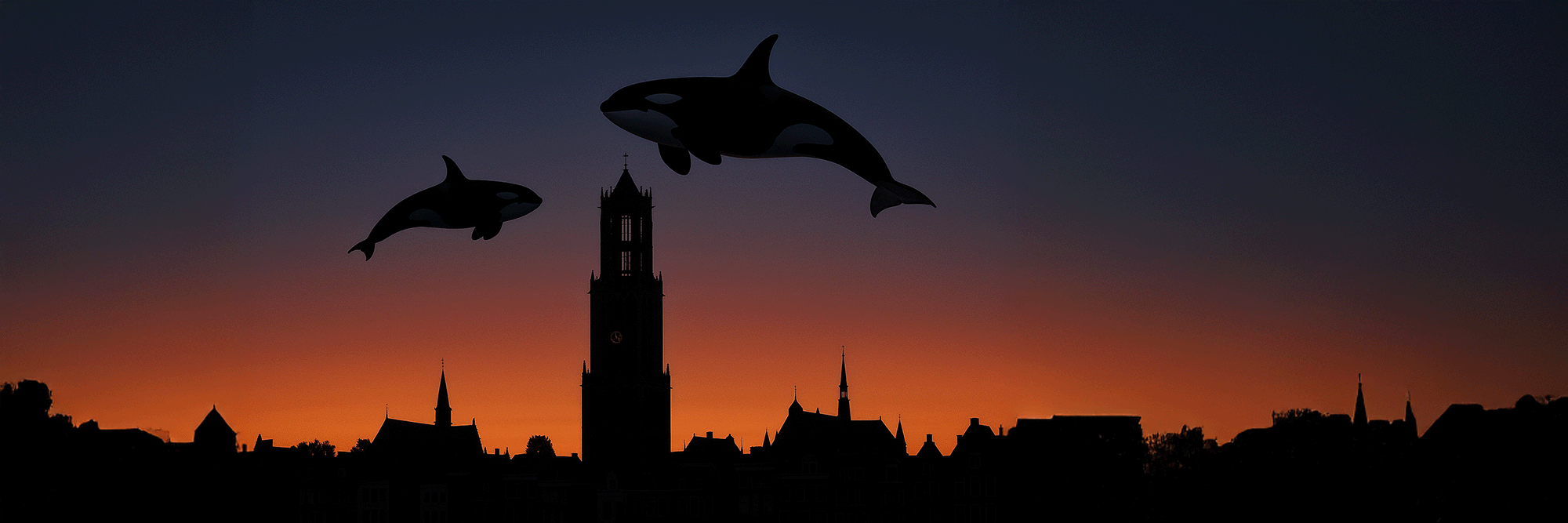
Marie Comuzzo (Brandeis University.), “Listening with Comrade Orca: Becoming Better Animals Through Multispecies Solidarity”
Abstract: Following the viral news that orcas are sinking yachts off the coast of Spain, social media platforms have been flooded since May 2023 with memes celebrating comrade orcas. Human fans cheer them on for their anticapitalistic courage in moving against billionaires. Memes featuring images of orcas accompanied by text such as “become ungovernable” or “the earth will shed the virus of capitalism | join the orca uprising.” Centering nonhuman agency in resisting colonial-capitalism highlights the insurrectionary multispecies resistances has always accompanied the death march of capitalism “development.” What does it mean to be comrade with an orca? And how can we learn from whales to oppose a system that is taking away our shared future? I argue that to establish true comradeship with whales one needs to listen to and feel with them the reality of our shared concerns. Then, as comrades, seeking political change together. Indeed, legislations to protect orcas, whales in general, and the ocean have countless benefits for humans as well, as less glamorous but equally important members of the ecosystem are able to regenerate. In 2024, in a historical treaty led forward by Māori legislations, whales obtained legal personhood in Polynesia. This is a culmination of intergenerational work seeking to grant legal rights to nonhumans. In this example, the sought-after legislative reforms are not just rules to reduce boat speeds or create “sanctuaries,” but rather epistemic challenges to the whole legal framework that understands personhood as exclusive to humans. Indeed, it reflects a commitment to animism, perspectivism, and the more-than-human, all of which are at the core of kinship and reciprocity. Ultimately, becoming comrades with orcas would require us to develop our own concrete actions to support them while striving to become better animals, as we imagine and create a radically different future.
Bio: Marie Comuzzo is an ACLS/Mellon Innovative Dissertation Fellow and a Ph.D. Candidate at Brandeis University. Marie’s research examines how sound mediates the relationship between humans and whales and the political power that recognizing whales’ vocalization as music had in ecological conservation and multispecies kinship within and beyond Western imaginaries.
Wer Zieman (Nicolaus Copernicus University), “Marine Mammal Alliances: Affirmative and Affective Forms of Co-Creating Solidarity Through Conviviality”
Abstract: While dominant narratives of “Nature’s revenge” are creative and essential in drawing attention to the consequences of human actions, they often reify the human-nature binary and reaffirm human exceptionalism. This presentation, aiming to deepen the dialogue on nonhuman agency, proposes a complementary exploration of nonhuman resistance through the lens of feminist revolutionary theories, emphasizing the creative value of affirmative affect, cooperation, and the vitality of body and matter.
I focus on the concepts of “becoming-with” and multispecies alliances, rejecting speciesism and hierarchical divisions that often define conflict. Acknowledging the significant challenges of considering human-nonhuman relations given profound power imbalances and far-reaching anthropogenic impacts on the marine environment (including climate change, pollution, hunting, and captivity), I center on cases of interspecies relationships among marine mammals based on conviviality and shared play. The aim is to investigate how these collective practices, driven by affirmative affect, can offer alternative forms of resistance and survival in spaces touched by oppression. I argue that this approach, drawing on concepts of transversal evolution, is particularly useful for considering diverse positionings within networks of agency and uncovering their transformative potentials, promoting conceptions of multispecies justice and coexistence. This presentation seeks to deepen critical dialogue within the environmental humanities, fostering solidarity between ecocriticism and animal studies, and inspiring collective action towards a future where human and more-than-human worlds can thrive together.
Bio: Doctoral student at the Doctoral School of Humanities, Theology and Arts at Nicolaus Copernicus University in Toruń. Their research interests lie at the intersection of feminist new materialisms, blue humanities, and posthumanism. They are particularly engaged with questions of knowledge production within science and technology studies (STS) and explores alternative research methodologies, including diffractive approaches. Their work addresses contemporary challenges related to the environmental crisis, emphasizing the need for ethically responsive, situated, and materially engaged academic practices.
Mandy Bloomfield (University of Plymouth), “Lines Cast Otherwise: Poetic Countercurrents in Capitalocene Oceans”
Abstract: This paper considers poetic engagements with histories and practices of fishing. Industrial-scale fishing materially and imaginatively constructs oceans as sites of extraction and sacrifice zones where marine ecologies – and in many cases human rights – are decimated in pursuit of profit. I’ll examine how post-war poets situated in different geographies critique the ecological injustices of industrial fishing but also conjure alternative relations with oceans and their inhabitants. Charles Olson’s depictions of his hometown of Gloucester, Massachusetts in his epic Maximus Poems traces long, entwined histories of fishing, colonisation and the extractive imperatives of market capitalism. Derek Walcott’s Omeros depicts the struggles of subsistence fisherman Achille in a contemporary Caribbean amid waters dominated by the “voracious, insatiable nets” of industrial trawlers. Craig Santos Perez’s recent poetry laments the effects of military-industrial practices on marine ecologies and Indigenous relations with the more-than-human oceans in the Pacific. Jorie Graham’s “Deep Water Trawling,” meanwhile, imagines industrial bottom-trawling from the perspective of a personified ocean bed. While critiquing the dominant extractivist and polluting currents of industrial fishing in Capitalocene oceans, these poets also draw on practices of fishing to figure alternative ocean imaginaries and modes of ecological relation.
Bio: Mandy Bloomfield is Associate Professor in Modern and Contemporary Literature at the University of Plymouth, where she teaches literary studies and environmental humanities. The author of Archaeopoetics: Word, Image, History (University of Alabama Press, 2016) she has published numerous essays on contemporary ecopoetics in journals such as ISLE, Contemporary Literature, Green Letters, Configurations and The Cambridge Companion to Literature and the Anthropocene. She is currently working on a monograph on oceanic ecopoetics.